Blog
Why you shouldn’t trust AI to design your brand logo
Why you shouldn’t trust AI to design your brand logo

Recently, a prospective client reached out to us with a small branding project. This municipality had just updated its logo and the designer who created it didn’t provide them with scalable vector files. They asked if we could recreate the exact logo and provide them with those files.
We suspected why the designer only provided png and jpg formats. More than likely, they had created the logo using an AI program that didn’t create vector files. When we saw the logo, it confirmed what we thought.
AI can do a lot of impressive things. It can draft emails, summarize reports, and yes — it can generate a logo in under 30 seconds. For a small business owner or municipality staring down a tight budget and an even tighter timeline, that sounds like a dream. Type in a few keywords, click a button, and walk away with a polished mark ready to slap on a business card.
But here’s the quiet truth we’ve learned after years of building brands: a logo isn’t a graphic. It’s a decision. And decisions about how your brand shows up in the world deserve more than an algorithm’s best guess.
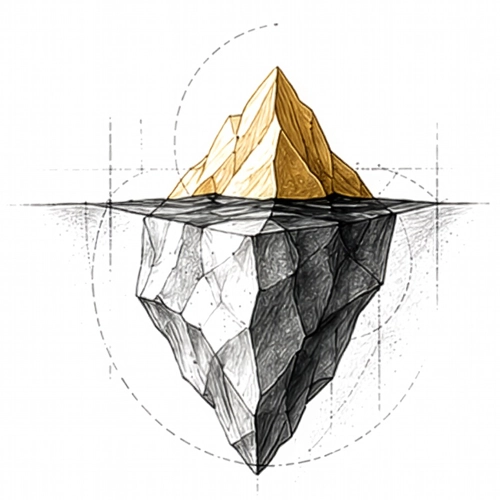
A logo is the tip of the iceberg
When a client hires us to design a logo, we don’t start with shapes and colors. We start with questions. Lots of them.
Who are you trying to reach, and what do they already believe about businesses like yours? What feeling do you want someone to have three seconds after they see your mark? What are your competitors doing and, more importantly, what are they all doing the same way that you could deliberately break from? What’s the story behind how your company started? What words would your best customer use to describe working with you?
These questions aren’t filler. They’re the raw material for everything that follows. The answers shape whether your logo should feel established or upstart, warm or precise, traditional or surprising. They inform whether we lean into a serif that suggests heritage or a geometric sans-serif that signals something more modern. They tell us whether your color palette should feel like a handshake or like a spotlight.
AI can’t ask these questions the way a strategist can. It can prompt you for keywords, but it can’t read the hesitation in your voice when you describe your ideal customer. When you say “I want it to look professional,” it won’t ask the right follow-up questions that uncover what professional actually means to you and the people you serve.
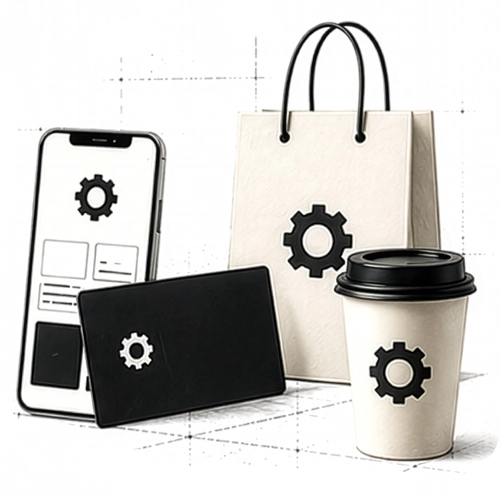
Your logo doesn’t live alone
Here’s something AI tools rarely account for: your logo is one piece of a much larger visual identity system. It needs to coexist with your typography, your color palette, your photography style, your voice and tone, your packaging, your website, your signage, your social presence, and yes — even the way your invoices look.
When we design a logo, we’re designing with that whole ecosystem in mind. We’re thinking about how it holds up at the top of an email and embroidered onto a polo shirt. (This particular logo was laden with details that will get muddy in smaller applications.) We’re planning for the moment two years from now when you need a submark for a new product line, and we’re making sure the system can stretch without breaking.
AI generates a logo in isolation. It doesn’t know what your website is going to look like, because your new or updated website doesn’t exist yet. It can’t design a system — it can only produce an image.
Originality is a strategy, not a happy accident
AI models are trained on the work of human designers. Millions of logos. Which means AI output tends to converge on what’s already common — the averaged-out middle of what logos look like right now. Swooshes. Abstract leaves. Geometric monograms. Gradient orbs.
That’s a real problem, because the entire point of a logo is to make you memorable and distinct. If your mark looks like it could belong to any of a hundred other companies in your category, it’s not doing the job you need it to do.
A good human designer is actively working against sameness. We’re looking at what everyone else in your space is doing so we can do something different on purpose. AI has no incentive — and no ability — to do that.
The trademark problem no one talks about
This one catches business owners off guard. When AI generates a logo, the legal status of that design is murky at best. Depending on the tool and jurisdiction, AI-generated work may not be eligible for copyright protection in the way human-created work is. That means someone else could theoretically use the same mark, and you may have limited recourse.
Worse, because AI pulls patterns from training data, there’s a real risk of accidentally producing something that too closely resembles an existing trademarked logo — leaving you exposed to costly legal disputes down the road.
When you work with a designer, you get clean ownership of original work.
Nuance is the job
The best logos we’ve designed came from conversations that surprised the client. Sometimes a throwaway comment in a discovery meeting — “my grandmother started this business in her kitchen” — becomes the seed of a whole visual direction. Sometimes we realize halfway through the meeting that the client doesn’t actually need the logo they asked for; they need a different one that does a better job of selling who they really are.
That kind of insight doesn’t come from a prompt box. It comes from a person paying attention to another person, asking follow-up questions, and noticing what the client didn’t quite know how to say out loud.
What you’re really paying for
When you hire an experienced marketing professional to develop your logo, you’re not paying for the final file. You’re paying for the thinking, the listening, the strategy, the revisions, and the hundreds of small decisions that went into making a mark that feels inevitable once you see it.
You’re paying for a brand that holds up when your business grows in ways you can’t yet predict. You’re paying for the difference between a logo that looks fine and a logo that works — one that earns recognition, builds trust, and still feels right ten years from now.
AI can produce an image. We build an identity. There’s a meaningful difference, and your brand deserves to know which one it’s getting.
Ready to build a logo that actually reflects who you are?
Let’s start with a conversation.